For Anyone Interested in the Wildlife of the U.K.

 Noble False Widows
Identify It > Spiders Section > Noble False Widows >


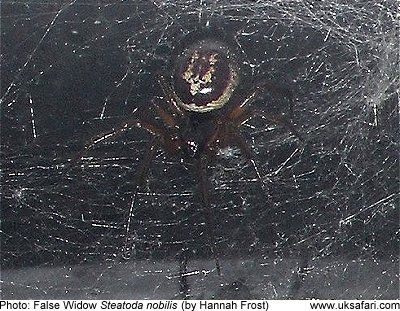
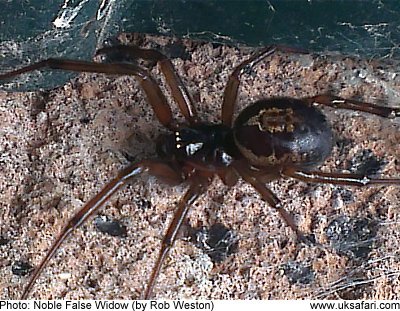
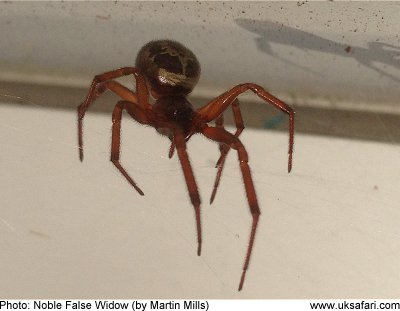
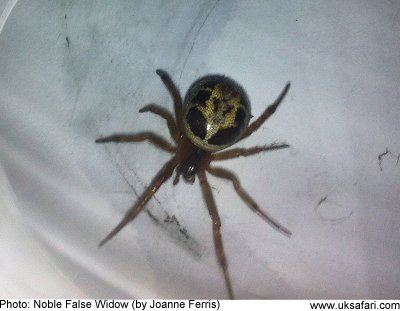
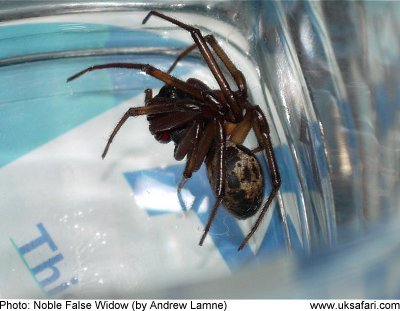


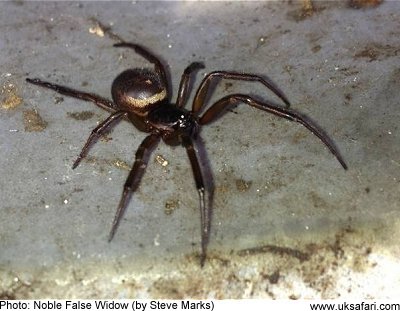

Scientific name: Steatoda nobilis
Size: Head and body 7 - 14mm
Distribution: Found in most parts of England and South Wales. Recently reported sightings were in South London, Bristol, North Wiltshire, Gloucester, Berkshire, West Sussex and Norfolk
Months seen: All year round
Habitat: Usually found in houses and out buildings
Food: Flies and other small insects
Special features: The Noble False Widow spider (Steatoda nobilis) probably arrived in the UK from the Canary Islands. It was first recorded in Torquay, Devon, back in 1879. Since then it has adapted well to our colder climate.
False widows belong to a group of spiders which are part of the same family as the infamous Black Widow spiders, although they are nowhere near as toxic. They're frequently mistaken for Black Widow spiders, which has led to the common name of "False Widow" spiders.
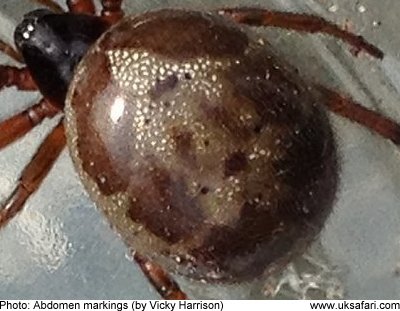
They have a dark shiny body. The abdomen has some pale markings on the top, and there is a creamy coloured band all round the front.
Under a hand lens this looks like an intricate mosaic.
The web of the false widow spider consists of many short, irregularly placed silk strands. It's a bit of a mish-mash.
False widows have a reputation for biting people, although in truth, this is quite a rare occurrence. You would need to be very unlucky, or go out of your way to be bitten. They only bite if mishandled or provoked. People who have experienced the bite say it's similar to a bee sting.
Visitor Comment
"I work as a washing machine repair man in and around Gloucester and Cheltenham. Since this introduction to the False Widow I have seen many, in many houses. Males and females alike and some with eggs I even repaired a washing machine that has a honeycomb-like structure in its base and I counted about 14 separate False Widows, each occupying it's own space and ranging from baby to adult, there were even eggs, so I guess by now the machine is slightly over-run with them I have lost count of the amount I've now seen but I see at least one approximately every two weeks" - Wayne Mills


Related Pages
- False Widow Steatoda bipunctata Fact File
- False Widow Steatoda Grossa Fact File
- UK Safari Spiders Section
- UK Safari Invertebrates Section
- UK Safari News